Tales from Los Angeles’ lost French quarter and Southern California’s forgotten French community.
Saturday, November 8, 2025
Immediate Demolition Threat to the French Hospital
Sunday, September 28, 2025
Edward Dupuy Tries to Pull A Fast One
I have never pretended that my fellow Francos were perfect. We've had a few bad grapes in the wine vat.
Today's post from the (online) Los Angeles French Museum showcases an illustrated trade card (i.e. early business card) from Edward Dupuy's feed store at 10 East Second Street. It reminded me of the time Dupuy (who was not related to the Pyrenees Castle Dupuys) tried to defraud a farmer and wound up in court.
I'll let the July 13, 1887 edition of the Los Angeles Times take it from here (paragraph breaks are mine):
It appears that on June 18th Louis Erbes, a farmer, drove up to the store of E. Dupuy with a load of potatoes for sale, and though other buyers offered to take them, sold the load to Dupuy for 70 cents a hundredweight, and they were unloaded in his store. As it was late, however, Dupuy did not pay for the potatoes, but told Erbes to call around the next day for his pay.
Erbes, being otherwise engaged, could not get around on the next day, which was Saturday, but called at the store early on Monday morning, during which time he heard that potatoes have gone down in price, and congratulated himself that he had sold on a falling market.
On reaching Dupuy's store, great was Erbes' surprise to find that his beautiful potatoes, which he had unloaded there on Friday night, were - according to the purchaser's story - rotten and of no use in the market at any price. In support of this information, Mr. Dupuy showed Erbes a sample of the tubers, which he said was taken from one of the sacks left in the store on Friday night.
Erbes could not believe that his beautiful "praties" had so deteriorated, and cutting open another of the sacks in the pile proved to Dupuy that they were all good in that sack, and wanted to open a few more in proof of his assertion.
At this, Dupuy got mad and said that he would not take the potatoes, and that unless Erbes moved them away he would have them "dumped." At this Erbes got riled also, and refusing to take away the potatoes instituted suit for the price of them, bringing witnesses into court who testified to the effect that the potatoes were of the best. Mr. Dupuy brought witnesses who testified to the contrary.
Justice Taney, having listened to the testimony in which it appeared that the falling market had something to do with the remarkable change wrought in the potatoes in so short a time, gave judgment in favor of the plaintiff for $37.50 - the full amount claimed - and costs.
What a scummy thing to do.
Sunday, June 29, 2025
The Forgotten Alley in the Fashion District
It's no secret that some Fashion District businesses are accessible only through alleys. Heck, the Santee Alley is quite well known to locals (and even tourists).
I never noticed that one of the District's alleys had a French name...but in my defense, it doesn't have any signage. You can only see the name on maps.
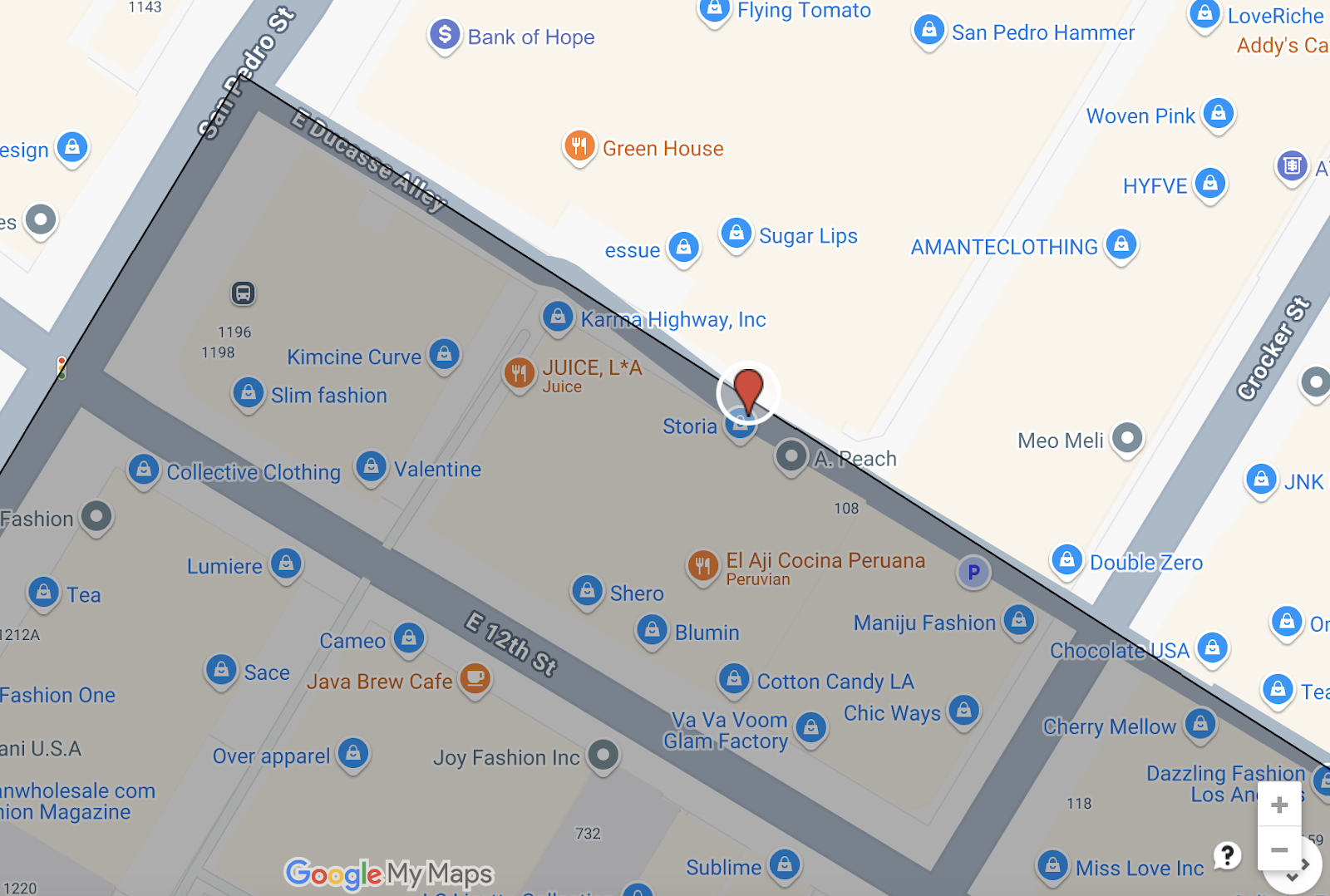
East Ducasse Alley, which runs from San Pedro Street to Crocker Street between 10th and 12th Streets, is all that remains of the Ducasse Tract. Mark at LA Street Names sent me this map of the Ducasse Tract, surveyed in 1889.
Peter Leon "P.L."Ducasse was born in San Francisco to French immigrants and worked as a court translator, translating both French and Spanish. He was an occasional delegate for the local Democratic Party, a sometime deputy, and a friend of local attorney M.V. Biscailuz. Ducasse was married to a woman named Margaret; they had two children named Grace and Eugene.
Ducasse's mother, Marie Larceval, died in 1886, leaving an estate. The land dubbed the Ducasse Tract was sold by Ducasse to James Pedgrift, John Grant, and James Smith in 1887.
Ducasse made the news a few times: he fought with another interpreter, complained about low wages, and on one occasion was arrested for assaulting a bartender who ejected him from the saloon. (One wonders if he had picked up some of Biscailuz's drinking habits; Biscailuz was known for drinking himself to the point of what a judge called "temporary insanity".)
Ducasse died in 1907 from sarcoma of the neck. It is perhaps fitting that a forgotten man lent his name to an alley that bears no signage to distinguish it from any of the other alleys downtown.
Tuesday, June 17, 2025
Save the French Hospital!
Dear Readers: the French Hospital is in danger of being torn down by a San Francisco developer.
I have sent the following letter to the Office of Historic Resources and to the Cultural Heritage Commission.
Should you wish to do the same, here is the Office of Historic Resources' directory and the Cultural Heritage Commission's email address is chc@lacity.org.
Dear Principal City Planner Bernstein et. al.,
The French Hospital Is Critically Endangered
In 1869, members of the French Benevolent Society laid the cornerstone of LA's original French Hospital - not in the French Colony, but a mile away on the edge of town where it was significantly easier and cheaper to buy four adjoining lots.
That original hospital building was a two-story adobe, and when the FBS ran out of money during construction, they opened the finished ground floor while raising more money to finish the upstairs. A wooden dormitory building was constructed onsite to house the nurses.
The hospital was rebuilt and modernized in 1915, then expanded in 1926, and it's long been rumored that a portion of the original adobe building is entombed within its walls.
The French Hospital became Pacific Alliance Medical Center in 1989, then became an urgent care center when it was sold to Allied Pacific in 2018. Allied Pacific rehabilitated the building rather than replacing it.
Unfortunately, this is Los Angeles, and a developer wants to tear it down for a mixed-use building. They are falsely claiming there are no historic buildings on the site.
Oh, and the developer isn't even local. Applicant AGI Avant Group Partners LLC is a Delaware corporation headquartered in San Francisco. Representative 531 W College LLC is also a Delaware corporation (although the two people associated with it are both in Alhambra).
I'm firing off a letter to both the Cultural Heritage Commission and the Office of Historic Resources right now (to be posted VERY soon).
Sunday, June 8, 2025
So I Had To Write Another Letter To The Editor...
Dear Editors:
Today's otherwise delightful article on LA's oldest restaurants contained a factual error.
It stated "At Philippe’s second, current home — where it’s stood since 1918..." and unfortunately, that's not accurate.
I have been working on a map of French and Francophone history in Los Angeles since 2013.
From 1908 to 1918, Philippe the Original stood on Alameda Street, south of Temple Street. The restaurant moved to Alameda Street east of Los Angeles Street in 1918. Another location (purchased by Philippe Mathieu in 1925) stood on Aliso near Alameda Street - the core of the now-lost French Colony. (In fact, all of the first three locations were within the French Colony's original boundaries of Aliso Street, Main Street, First Street, and the river.)
The restaurant stayed on Aliso Street until 1951 (you can even see it in the background of that infamous 1948 picture of a train crashing through a wall at Union Station and hanging over Aliso Street), when plans for the 101 prompted its move to its current location in Chinatown.
Thank you.
P.S. On a personal note, my parents used to go to Philippe's on dates.
Monday, December 2, 2024
All About the Amars
Le Guide Français claims that Edouard Amar's name "was once synonymous with San Pedro". I suspect this is a slight exaggeration, although I can confirm that he played a significant role in its history.
Like so many other French immigrants in Southern California, Edouard was a sheep rancher, raising tens of thousands of sheep on Rancho Alamitos while building some of San Pedro's earliest bungalows and developing Pacific Avenue's commercial district. In fact, a residential street in northeastern San Pedro still bears the name Amar Street and the San Pedro News Pilot dubbed him "the Father of Pacific Street".
Amar was well-liked; he was the Grand Marshal of the annual Bastille Day celebration in 1889, the one hundredth anniversary of the French Revolution. In 1889, San Pedro was relatively remote, much smaller than it is now, and technically not part of the City of Los Angeles (which didn't absorb San Pedro until 1909).
Amar's accomplishments sadly didn't shield him from tragedies. His first wife Marie Garineaux died at the young age of 32 in 1887, leaving Edouard to raise their two-year-old daughter Irma.
Edouar remarried the following year, this time to Josephine Boisserand, who hailed from his Alpine hometown of St. Bonnet.
By 1895, the Amars had lost three babies to croup - Edouard at one year, Emmanuel at one month, and Henri at nine months. Leon and Eloi survived infancy.
Leon was a bright, promising student who played cornet in the Angel Gate youth band, served as president of the Fifteenth Street School's literary society (Fifteenth Street School, which is now an elementary school, also housed San Pedro High School at the time), and began attending Santa Clara College in San Jose at seventeen.
Unfortunately, Leon was also diabetic, and diabetes was much harder to treat in the early twentieth century than it is now. His health took a turn for the worse in 1912, and in September of 1913, his worsening condition resulted in being taken to Sisters' Hospital (aka St. Vincent's), then located in Echo Park.
Leon's surviving siblings were summoned. Irma, by this time married and living in San Francisco, could not get to Los Angeles in time to say goodbye to her youngest brother. Eloi, who was in Imperial County at the time (Edouard owned a ranch in Brawley), was also unable to get to the hospital quickly enough. Leon's remains were handled by Godeau & Martinoni, with a funeral at the Plaza Church and interment at Calvary Cemetery. Six of his schoolmates served as pallbearers.
![]() |
| 1938 press photo of Eloi Amar |
Eloi was a football star at St. Vincent's College (Loyola Marymount University), spent a year studying in Europe (picking up French, Spanish, Italian, and even Basque), raised sheep with his father and cattle on Catalina Island (of which he was general manager under the Bannings and the Wrigleys), got into the mercantile business, and was organizer and president of the San Pedro Golf and Country Club. He was a very popular man about town in San Pedro; hardly any organization didn't boast Eloi or his wife Bessie as a member.
Eloi eventually became president of the Harbor Commission. It would prove to be his downfall - at least temporarily.
Dr. Geraldine Knatz has a great write-up on Eloi's alleged misdeeds, so I won't rehash it here. TL;DR: gambling.
But don't feel too bad for Eloi. While he was found guilty, he soon landed a job as General Manager of the Long Beach Harbor Department and got his revenge on Los Angeles by shifting as much business as possible to Long Beach, which was flush with oil money at the time.
Wednesday, February 28, 2024
Gone Too Soon: Pierre Louis Eschardies
Pierre Louis Eschardies Jr., known as "Pete" to his friends, had it all, or was about to.
Tall, dark, and athletic, Pete was born in Los Angeles to French immigrant parents in 1893. He was named for his uncle Pierre and his father Louis.
Pete may have been mechanically inclined from a young age - the 1910 census lists a teenage Pete as a helper in a foundry.
Pete was a noted amateur boxer, a member of the Los Angeles Athletic Club, and according to the Los Angeles Herald "one of the most daring road drivers who ever tackled a mountain race."
The automobile industry was young, and Pete was already one of its rising stars, at least on the West Coast.
Pete worked for J.W. Leavitt, first as a mechanic, then adding sales to his skill set.
Leavitt's firm sold Overland and Willys-Knight cars, but took over Chevrolet sales from the Ryus Motor Car Company (sources disagree over whether this was in 1916 or 1917).
In 1915, the manager of Chevrolet's sales division and driver Fred Aubert came up with the idea of demonstrating the new Chevrolet 490 by lighting up Mount Wilson on Labor Day evening and racing the car to the top, setting a record driving time of 36 minutes (hey, it was 1915!). The race took place again on Labor Day, 1916, but Aubert was injured in an accident on a practice run, and a replacement driver had to be arranged on very short notice. About twenty Chevrolet salesmen clamored for the chance, but Pete, or "Wild Pete", as the newspaper called him, was selected.
Pete spent Labor Day in its entirety making practice runs up and down Mount Wilson to familiarize himself with the 120 curves along its 9.5 miles of road. By 7:30 pm, it was dark and foggy, and Pete was tired, but about a thousand spectators were waiting to watch Pete drive the 490 up the mountain.
In the words of the Los Angeles Herald:
With a roar and a blast Pete was on his way. With lights flashing in and out around the curves and in the canyons, he climbed rapidly upward until he was lost in a fog bank three miles from the top. A few minutes of anxious suspense and then a great red flare broke out at the summit announcing that he had arrived safely.
Pete not only made it to the top of Mount Wilson despite the fog and a long day of practice runs - he set a new record of 35 minutes.
Pete quickly worked his way up to Chevrolet sales manager in 1918 at the tender age of 25. The buzz around Auto Row that summer was that Pete was going to marry his sweetheart, Esther Lind, and then go off to fight in World War One (he had registered for the draft the year before). It didn't quite pan out that way.
Shortly after World War One ended, the Spanish influenza pandemic broke out, and several members of the Eschardies household were stricken.
The Spanish flu was a brutal killer, claiming the lives of many otherwise perfectly healthy adults. On the night of January 8, 1919, it became apparent that Pete was not going to live for much longer.
Despite quarantine restrictions, someone sent for Esther Lind and a minister. Esther stood on the Eschardies' porch, Pete's bedside window was opened, and the minister performed the marriage ceremony.
Pete died the next day and is buried at Calvary Cemetery.
Tuesday, February 27, 2024
The French (and Italian) Funeral Home
It's not exactly a secret that San Francisco had quite a large French community of its own. Hell, San Francisco had an active French Hospital until relatively recently (it still exists, but is now a "campus" of a larger hospital).
Julius Stephen Godeau, who went by J.S. Godeau professionally, was born in San Francisco to French immigrant parents. He was a director of the aforementioned French Hospital and belonged, incredibly, to 40 fraternal organizations.
Atkins-Massey, founded during the Gold Rush and by far the oldest funeral home in the city, went up for sale in 1895. Godeau snapped it up.
Godeau went on to open an Oakland branch, and much later, one in Stockton. But in 1910, Los Angeles beckoned.
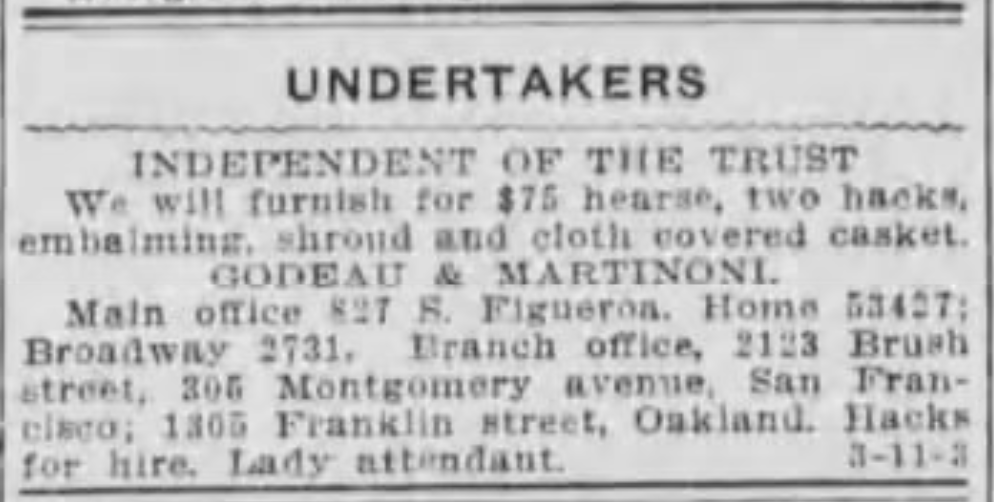
| Ad for Godeau & Martinoni, March 11, 1910. Do note that "Lady attendant" probably refers to Katherine Martinoni. |
Godeau knew that the growing city of Los Angeles had large French and Italian communities, and sought to tap that market. But he couldn't be everywhere at once, and travel took longer in those days. So he took business partners for the Los Angeles branch - James Martinoni and his wife Katherine Piombo Martinoni. (Godeau and Martinoni may have known each other due to their mutual membership in a fraternity, the Ancient Order of Druids.) James held the role of funeral director, Katherine was a mortician.
Yes, there was a woman working as a mortician in Los Angeles over 100 years ago. Pretty cool, huh?
| Excerpt from James Martinoni's 1914 death notice. Like Godeau, he was a high-ranking member of multiple fraternities. |
| 1910 news blurb from the Times. Godeau's membership in 40 fraternities very likely brought in a good amount of referral business, as in this case of a deceased Mason. |
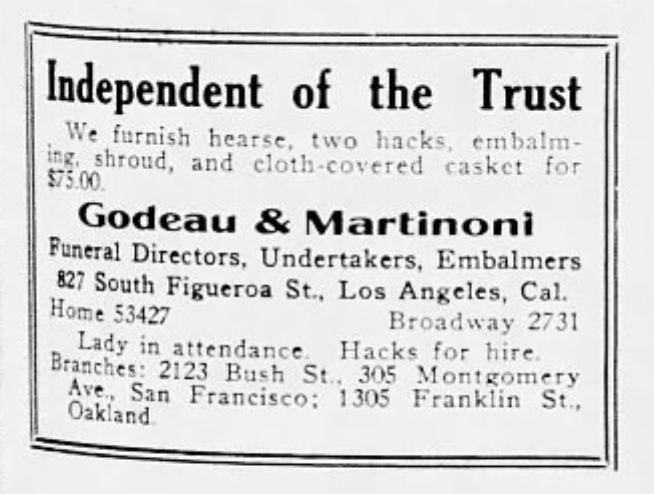
| 1910 ad from The Tidings, published by the Society of St. Vincent de Paul. |
In an interesting coincidence, J.S. Godeau poached a hardworking teenage boy from a rival's casket business - Raymond Malburg, future son-in-law of J.B. Leonis - to work at the Los Angeles branch. Raymond, who had started out building coffins, became a mortician himself.
In Godeau and Martinoni's early days, the mortuary was located at 827 South Figueroa Street, and young Raymond lived onsite (as did the Martinonis). It later moved to "Mortuary Row" on Washington Boulevard.
The Martinonis' niece, Florine Olivieri, helped with the books while earning her degree in Accounting at Southwest University.
It's not unusual for members of an ethnic or cultural community to patronize each others' businesses, and Godeau and Martinoni received a good amount of their business from the French and Italian communities of Los Angeles.
| 1913 funeral announcement for Leon Amar, teenage son of San Pedro pioneer Edward Amar. |
| 1912 funeral notice for French immigrant Emil Louis Barclay. The notice references the Court Français and the Legion Français - one wonders if Godeau belonged to either or (more likely) both. |
| 1913 funeral notice for Italian immigrant Mary Magdalena Zanoni |
| 1913 funeral notice for French immigrant Joseph Luquet |
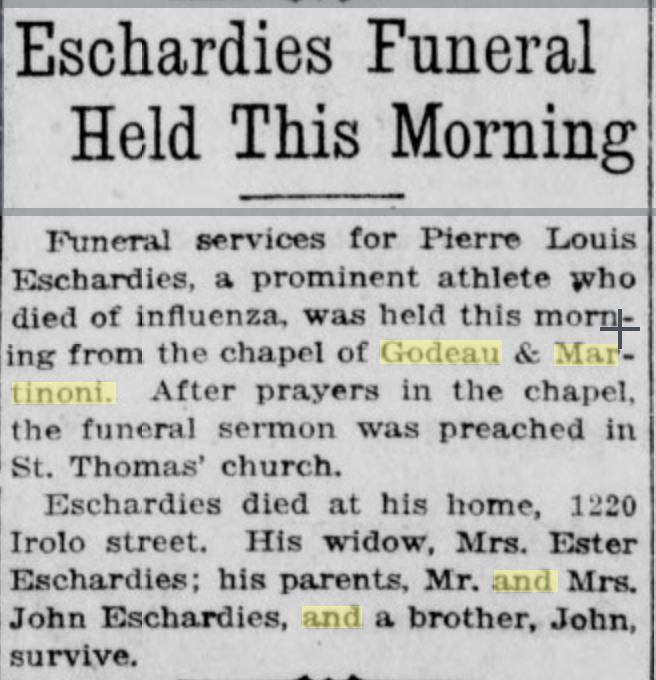
| 1919 funeral announcement for Pierre Louis Eschardies. |
| 1913 funeral announcement for French immigrant Antoine Begon |
There are far too many funeral notices to post here; suffice it to say that Godeau and Martinoni was a very busy firm for decades.
Godeau and Martinoni even handled the funeral for Mickey Cohen's infamous bodyguard Johnny Stompanato.
When Katherine Martinoni passed away in 1938, 30-year-old Florine took over as senior partner (working with two transplanted brothers from Ohio, Dick and Frank Palmieri), staying until her own death in 1968.
J.S. Godeau's Bay Area funeral homes closed in the 1970s. Godeau and Martinoni was bought out by Pierce Brothers in 1984.
Sunday, November 19, 2023
Jean Trébaol Vanishes
Sometimes, people just disappear.
It's much less common in the digital age. It would have been relatively easy to vanish without a trace - either intentionally or unintentionally - in 1919, when Jean Trébaol was last seen alive.
Born in Brest, he came to the States in 1893 at the age of 24, and soon married another Brest native, Jeanne de Kersauson de Pennendreff. The couple rented a house at 125 4th Street and would eventually have fourteen children (with thirteen surviving infancy).
Jean was a teacher and linguist, but took a job editing the French-language newspaper Le Progrès either with or under the notoriously unsavory J.P. Goytino. A squabble prompted Jean to leave and establish his own paper, Le Français. He boasted in English-language advertisements that Le Français was "the only French newspaper in Southern California established, published, and owned by a Frenchman."
This must have come as quite a surprise to Pierre Ganée, a fellow French immigrant who established, published, and owned rival paper L'Union Nouvelle.
The Herald published an article in 1897 about Constance Goytino (wife of J.P. and daughter of Joseph Mascarel) horse-whipping Mme. Trébaol outside a courtroom after a hearing. Jeanne's 17-year-old brother Robert, who was to inherit a considerable sum of money, had nominated J.P. as his legal guardian. Jeanne and her sister Isabel had concerns about Goytino's appointment. Constance also accused the Trébaols of trash-talking her. Jean sent a letter to the Herald politely informing them that Constance had attacked Jeanne unprovoked, that Jeanne had not actually taken the stand, and that "Judge Clark granted what we were intending for, namely, that Goytino as a guardian be put under heavy bonds and be restrained from incurring any liabilities on the principal of his ward."
Le Français merged with L'Union Nouvelle in 1900, and Jean went back to teaching.
With a large family to support and teacher pay being less than robust, Jean had more than one job. He taught French at Los Angeles High School, taught night classes at Polytechnic High School, taught at the Ebell Club of Pasadena, and taught privately.
He also wrote for the Herald occasionally. Of particular note is Jean's 1901 essay "The Corset Question". While Jean wasn't 100 percent correct on the history of corsets, he expressed concerns over the health effects of tightlacing and predicted - correctly - that some women would continue to wear body-shaping undergarments (although these days waist trainers and other shapewear are far more common than corsets) instead of embracing their natural shape. While he chalks this up to vanity, I surmise he was unaware of the pressure to look a certain way that many women still face, well over a century later.
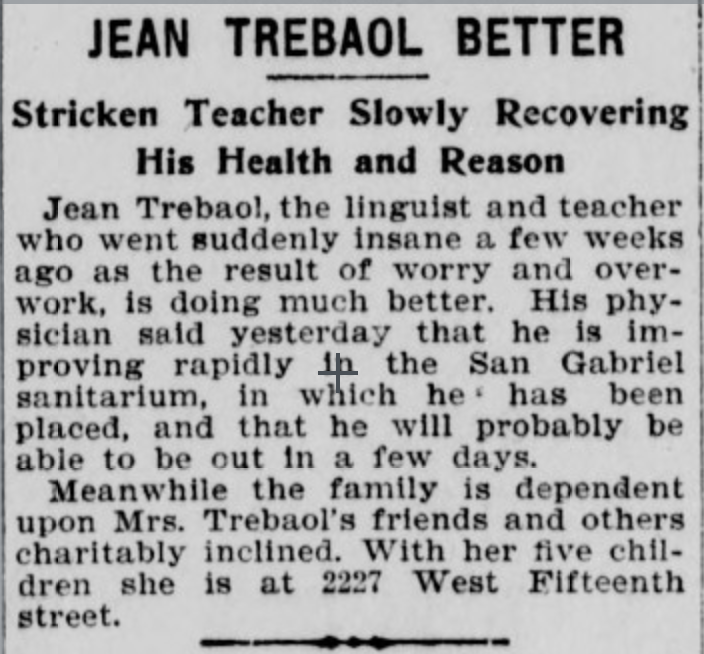
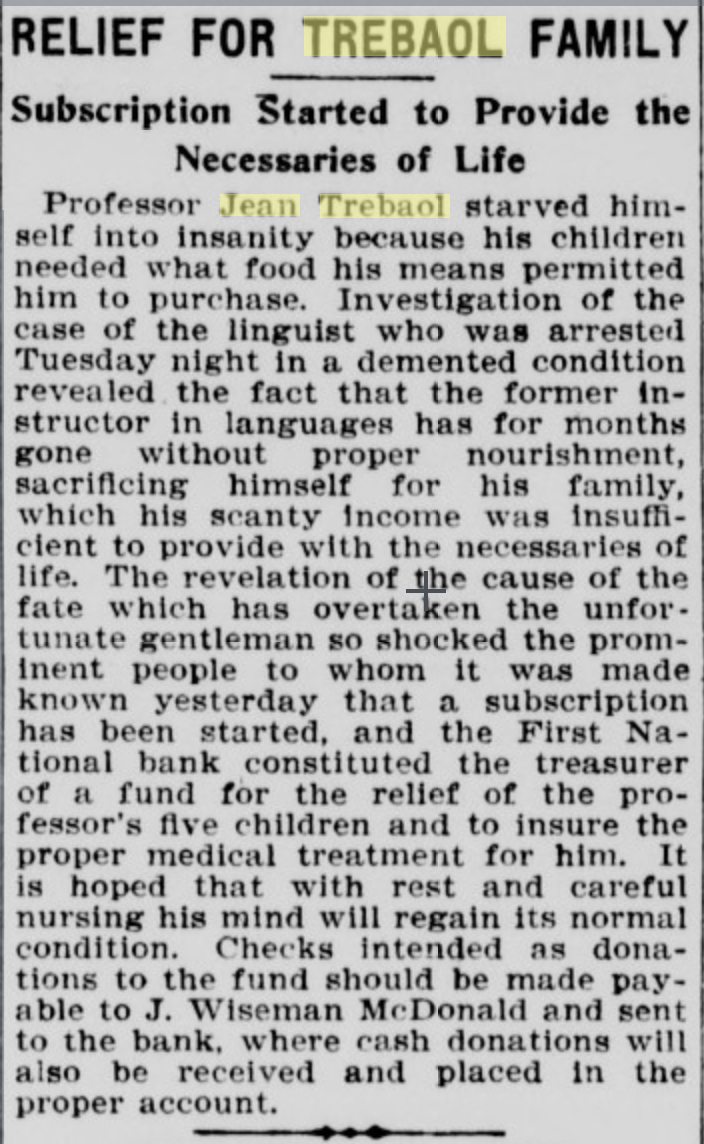
In 1903, Jean suffered a breakdown from stress, overwork, and starving himself for months to feed his children. He was sent to the San Gabriel sanitarium for a few weeks to recover. A newspaper blurb solicited financial assistance for the Trébaols, who had five children by this point. (Given the date of the article and the birthdates of their children, Jeanne would have been caring for 8-month-old Yvonne and was already expecting Edouard.)
| 1903 blurb regarding Jean Trébaol's hospitalization due to a breakdown |
| Blurb regarding a subscription, or donation fund, for the Trébaols |
Jeanne was appointed legal guardian to her husband after his breakdown. A real estate transaction listed in the newspaper suggests she sold the family home on his behalf.
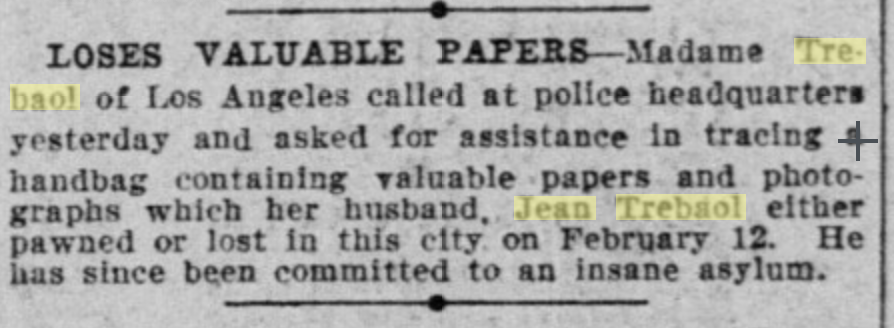
| 1909 newspaper blurb mentioning Trébaol's second hospitalization |
A snippet from one of the San Francisco papers indicates that Jean lost or pawned a bag filled with important papers and photographs (which were an expensive luxury in 1909) prior to being committed to a mental hospital again. Jeanne came to San Francisco and requested police assistance in locating the bag.
When World War One broke out in 1914, Jean tried to enlist. He was turned down due to being in his forties and having thirteen living children. (Georges Le Mesnager, by contrast, had five children, four of whom had reached adulthood.)
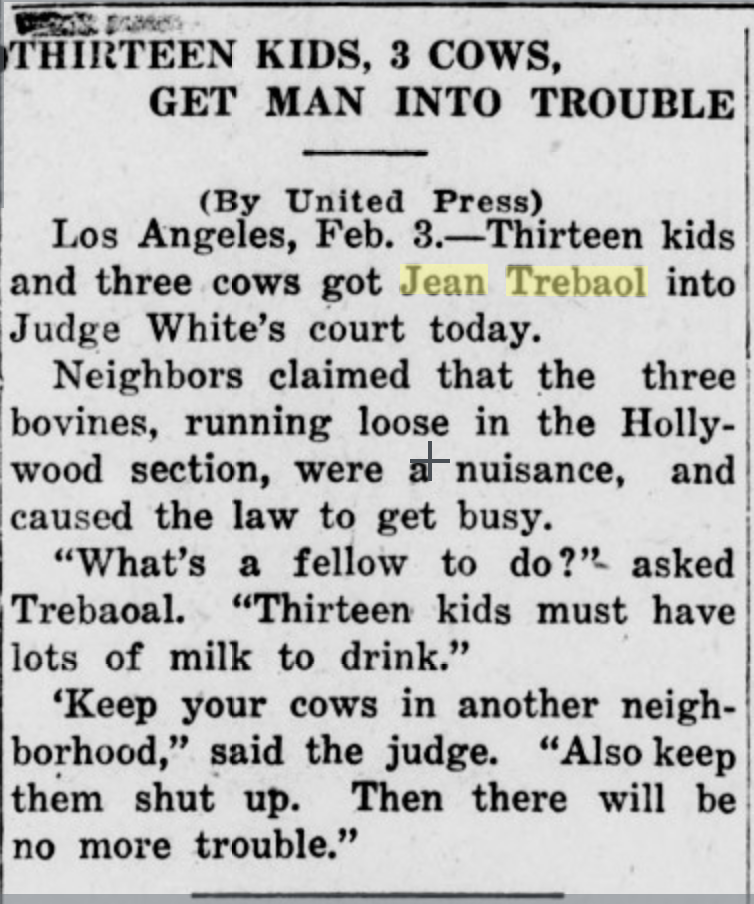
The Trébaols moved to Hollywood, which was still semi-rural. The family's three cows got out one day, prompting the judge to order Trébaol to keep them in another neighborhood and secure them properly.
| 1917 blurb about the Trébaol family's cows escaping |
Jean took a job at the French Consulate for a while, then accepted a teaching post at the Mare Island YMCA in Vallejo, teaching French to sailors from the naval base bound for France. He published a small textbook related to this post. The rest of the Trébaols remained in the family home in Los Angeles.
Jean was known to the staff of the Echo de l'Ouest, one of the Bay Area's own French-language newspapers. He stopped by the newspaper's office on May 31, 1919, appearing to be severely depressed, and told the staff that he needed a complete rest. According to them, he was not himself that day.
On June 1, Jean spent the night at the home of his brother René, who lived in Vallejo. The San Francisco Call stated that he was suffering from a nervous breakdown. He vanished the following morning.
Jean Trébaol was never seen again.
One colleague noted that there was talk of him drowning, which is certainly plausible given Vallejo's location on the Bay. It was widely assumed that he must have died in either an accident or - especially in the light of his apparent depression - by suicide.
Jean never found out that he had just been selected as the Vallejo schools' French teacher.
Jeanne came up from Los Angeles to search for her missing husband, but it was to no avail.
The California Historical Society Quarterly claimed that "Mascarel offered Madame Trébaol a house of prostitution as a good source of revenue after her husband's disappearance, but she declined, especially as she would have to live in it herself!" While the French Colony was known to step up for those in need, this story isn't even possible; Joseph Mascarel had passed away twenty years earlier in 1899 at the age of 83.
Jeanne DID need money, of course. She was a mother of thirteen living children, and although her two oldest children were in their twenties, the youngest was only four years old.
Six of the Trébaol children were already "appearing in motion pictures", as the Call put it, when their father disappeared. The other seven were soon looking for acting gigs as well.
Jean had suffered from memory loss during previous mental health episodes, and had once spotted a newspaper advertisement placed by Jeanne, recovered his memory, and returned home. Besides earning money in the movies, the family hoped Jean would see and recognize one of his children on the screen.
Older brothers Hervé and Oliver went overseas (presumably to fight in the war), returning in 1919 and going on to higher education (in Hervé's case, becoming a priest and serving for years at St. Mariana in Pico Rivera). Eldest daughter Cecile helped Jeanne keep house and worked as a telephone operator at night. The other ten siblings continued to act.
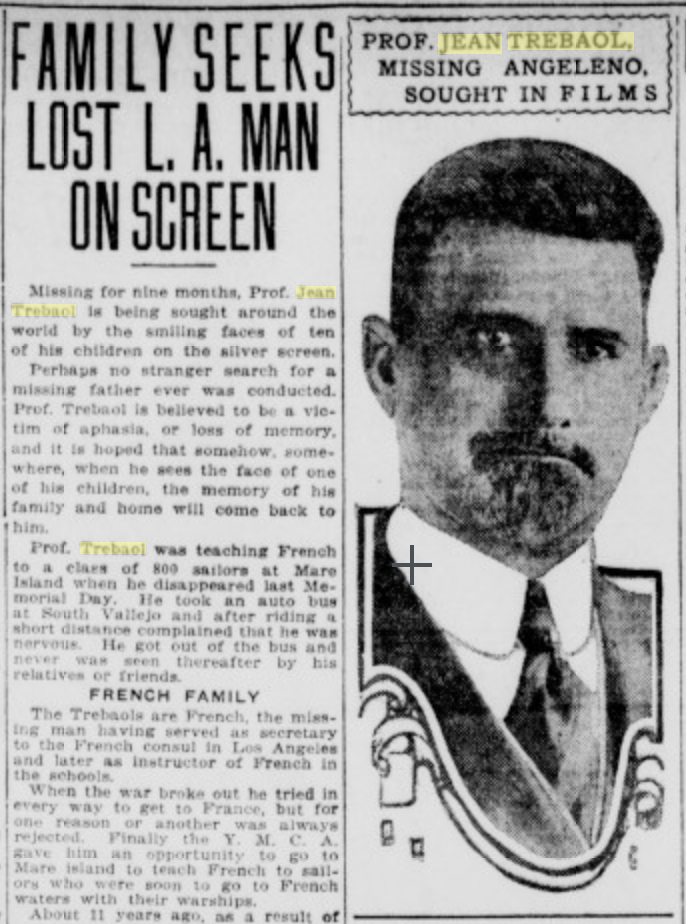
| 1919 news article with picture of Jean Trébaol |
When he was cast as the Artful Dodger in the 1922 version of Oliver Twist, Edouard told the San Bernardino Sun that "somebody asked mother to try to get some of us in the movies and so finally mother took a few of us around to picture studios. It was hard work, walking from studio to studio, and there was very little for us then. In fact it was many weeks before we received our first call. That was for a picture with Miss Pickford. Since then, the picture directors have been very kind. After they learned about our dad...they seemed glad to give any of us work when they could. Now every one of us is in pictures. Why, even mother herself sometimes plays."
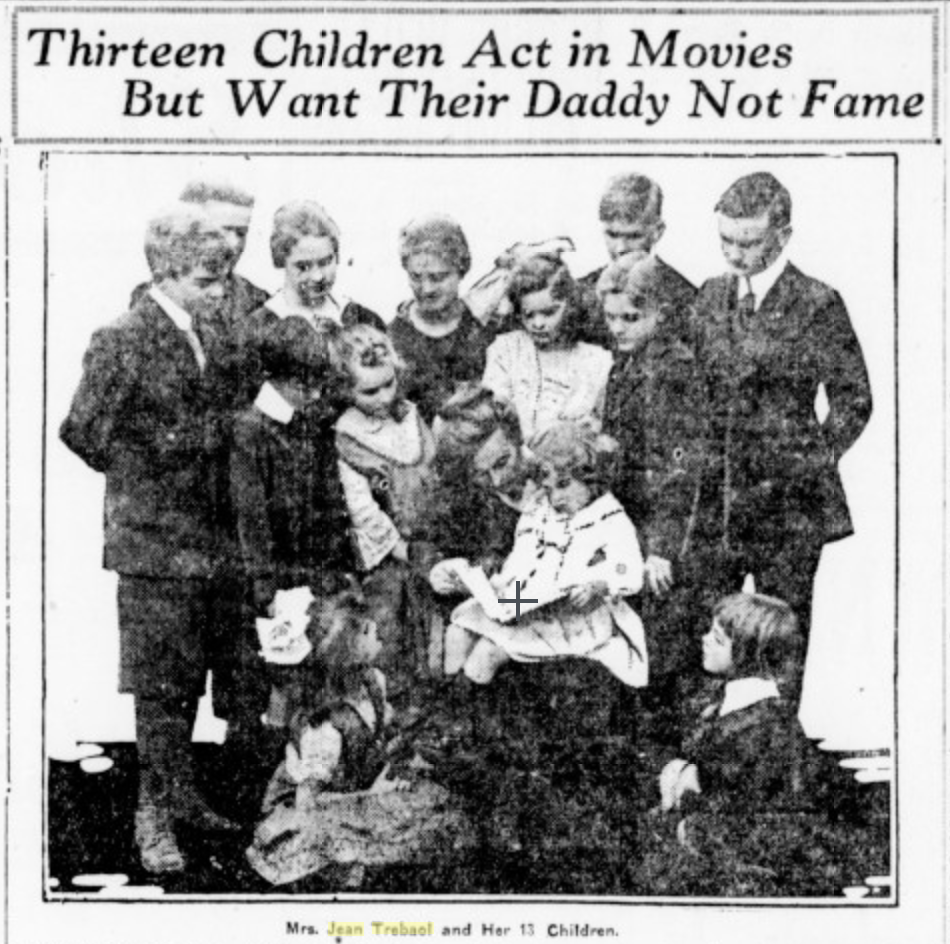
| 1922 picture of Jeanne with her 13 children. Headline reads "Thirteen Children Act in Movies But Want Their Daddy Not Fame." |
Out of the thirteen Trébaol children, IMDB lists acting credits for Edouard, Jeanette, François (credited as "Francis"), Philippe, Yves, and Marie. I hasten to add that in the very early days of the motion picture industry, actors were not always credited by name, and it's likely that the other children worked as extras or in uncredited roles, since Jeanne did.
In an interesting footnote, Jeanette was apparently not put off teaching by her father's struggles. A 1946 news article mentions her joining the summer school staff at San Pedro High School thirty years earlier, teaching English and Spanish. That fall, she stayed on, teaching at Polytechnic High during the day and night school in the evenings.
Monday, September 18, 2023
Clementine Lamer Did It Her Way
Clementine Lamer wasn't meant to live an ordinary life. How many Angelenos throughout history could accurately claim that they were born in the oldest brick house in the city?
Clementine was, in fact, one of her middle names. Born in 1859 to French immigrants Michel Clement and Marie Bon Clement, she was originally dubbed Marie Jeanne Clementine Clement (some records reverse her first two names) and had an older brother named Michel Victor (who also went by his middle name).
Michel was a farmer and vintner (newspapers indicated that he owned land next to the El Aliso vineyard), but later sold his winemaking business to his brother-in-law J.B. Bon. It isn't clear when the elder Marie Clement passed away, but Michel remarried in 1864, when Clementine was five.
Michel passed away when Clementine was thirteen. She attended the Sisters' School run by the Daughters of Charity.
In the meantime, a Québecois blacksmith by the name of Amable Lamer came to Los Angeles. Clementine married him when she was eighteen.
Amable soon went into the vineyard business himself, which led to a farm in Burbank. But Clementine pursued a passion of her own - real estate.
An 1884 newspaper account references a parcel jointly owned by Clementine and Victor. That parcel, along First Street east of the river, had previously been part of their father's land holdings. Three years later, a different newspaper gives notice of that parcel being sold by Clementine, Victor, their stepmother Jennie, and Amable. That parcel would later become the site of the Salt Lake train depot.
More news blurbs (too many to post) indicate Clementine's real estate transactions, sometimes with her brother, sometimes with her husband, and over time, mostly by herself.
Clementine was also a mother of six: Edward, Victor, Emma, Florence, Marie, and Louis. Tragedy struck in 1892 when 9-year-old Edward died.
| 1894 news blurb noting Clementine Lamer's purchase of bank-owned acreage |
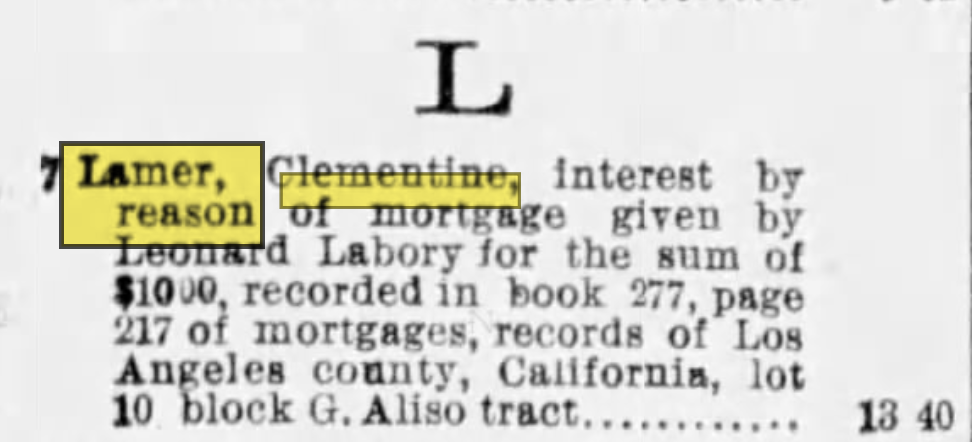
| 1895 mortgage record naming Clementine Lamer and Leonard Labory |
The above mortgage record names a transaction between Clementine Lamer and Leonard Labory - namesake of Labory Lane in Frenchtown. Note that the property is in the Aliso tract. By 1895, El Aliso was long closed, the winery had been converted into a brewery, and some of Jean-Louis Vignes' original property had been subdivided and developed.
In 1919, Clementine bought a bungalow at 553 Angeleno Avenue in Burbank. This wasn't one of her usual transactions, it was for her own family, and they moved in a month later.
| Details of Clementine Lamer's real estate deal |
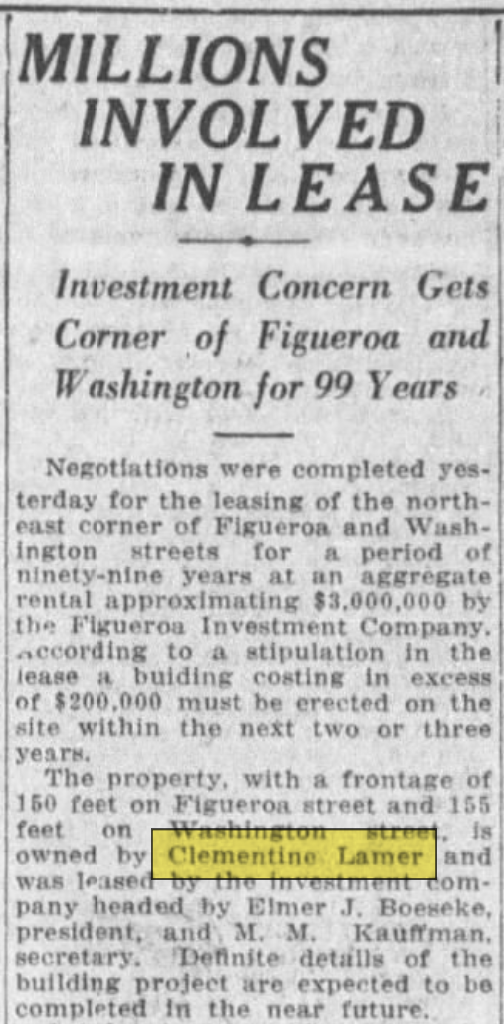
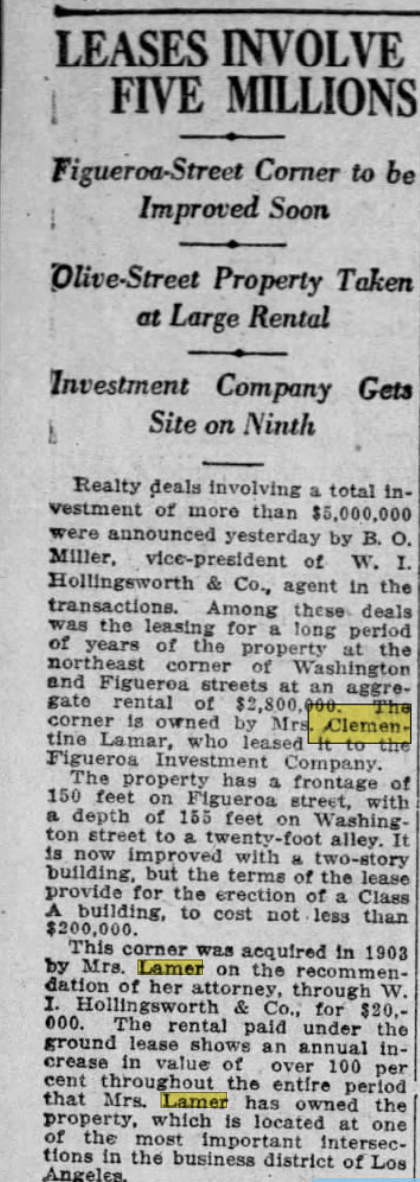
1924 article about a valuable real estate deal involving Clementine Lamer's property at 9th and Figueroa |
Clementine made a multi-million dollar deal in 1924: a 99-year lease on a Figueroa Street plot (the parcel in question is behind the Original Pantry Cafe). Clementine had bought it in 1903 for $20,000. The terms of her deal with the Figueroa Investment Company required them to replace the existing two-story building with a larger one worth at least $200,000 and to pay a total of $2.8 million.
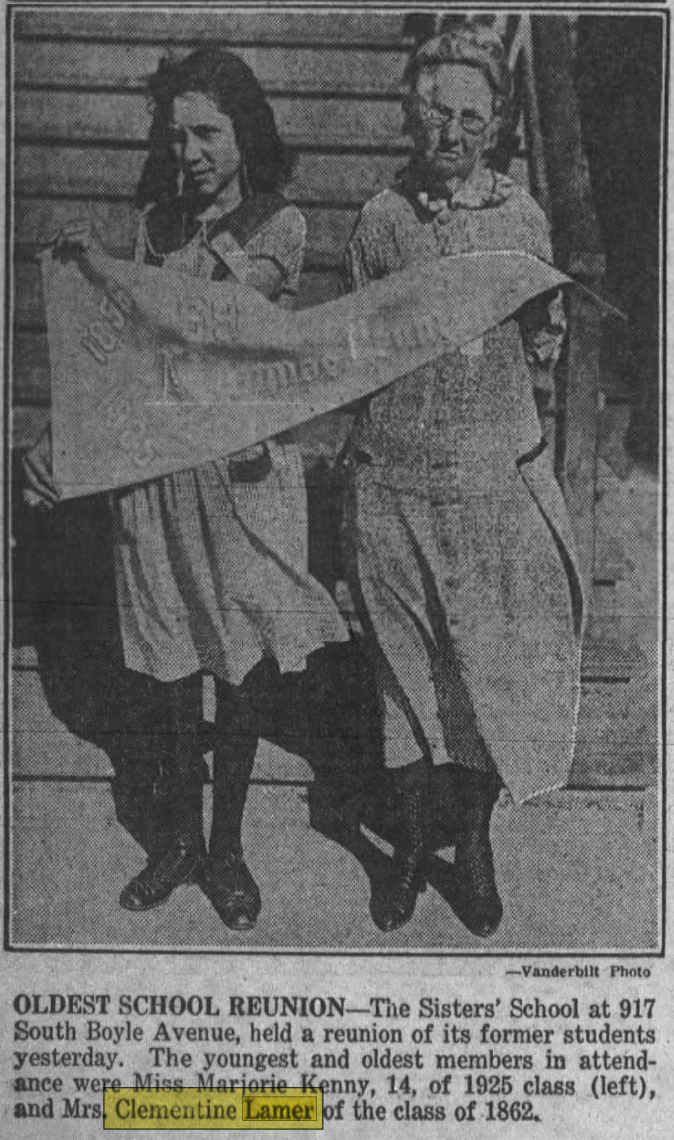
In 1925, the Sisters' School held an alumni reunion. The Daily News photographed the school's oldest and youngest former students together - namely Clementine Lamer and 14-year-old Marjorie Kenny.
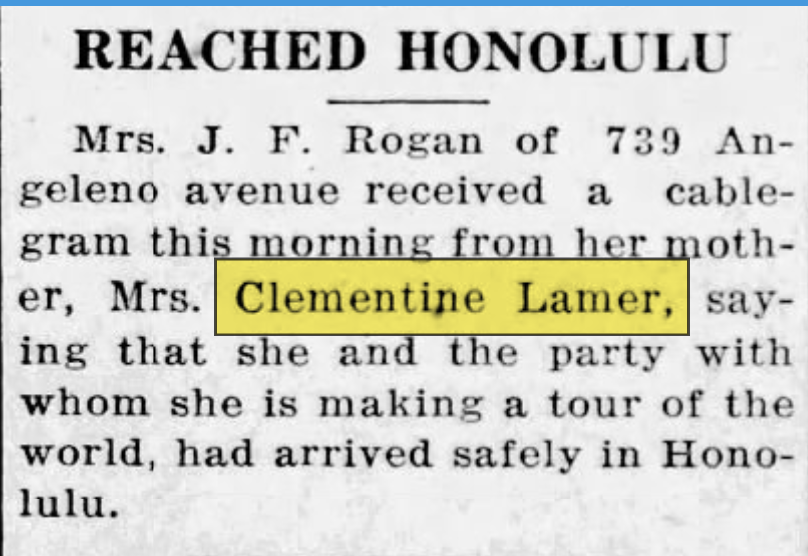
1927 news blurb about Clementine Lamer's trip around the world |
Thursday, August 10, 2023
What's REALLY Going On With Taix?
I won't rehash the entire lengthy saga of the battle for Taix French Restaurant. That would take far too long. Here's the Cliffs Notes version, with links. TL;DR: the whole thing is about as sketchy as it gets.
Last week, photographer Gary Leonard posted a picture of a freshly-desecrated Taix. The mature plants in the brick planters are gone, "TAIX" has been (badly) painted on the side of the building (right over the decorative half-timbering), and both the roof and the planters appear to be falling into disrepair.
I suspect this is a deliberate move to drum up support for demolishing the building by making it look as bad as possible while still keeping the restaurant open - for now.
No permit was filed for the sloppy "mural", and there is something very strange (and concerning) about the demolition permit that the developer, Holland Partner Group, filed three months ago. (No permit has been issued - YET.)
From the permit:
DEMO AN (E) 1 STORY BUILDING OF APPROX 15,167 SF SINGLE STORY RESTAURANT WITH 2,554 SF BASEMENT. CLEAR LOT OF CURBS, PLANTERS, LIGHT POLES, ASPHAULT, SHRUBS ETC. NOTE: INTEND TO KEEP THE BASEMENT IN PLACE, AS IS. THE BASEMEN WILL BE ADDRESSED IN THE SHORING PLANS
Take special notice of that last bit: leaving the basement.
Basements are RARE in Los Angeles, and California has very stringent building codes due to earthquakes. Leaving an old basement in place when a new development is planned makes little sense.
There is also the matter of precedent.
According to my friends at Esotouric, "We're not builders, but we are historians of redevelopment. And we know that in the past, when L.A. property owners wanted to cheaply get rid of an inconvenient building, they would leave the basement untouched, and often fill it with rubble from the building above, then pave over the parcel and have a lucrative surface parking lot until they got around to developing the land - sometimes decades later, sometimes never."
No one knows LA history better than Kim and Richard, and this does have the hallmarks of a potential cheap demolition. Filling the basement with debris and paving it would make entirely too much sense here, and it tracks with the worsening condition of the building. HPG could make money renting out parking spaces while waiting on permits, and the flea market already held on site could expand.
Assuming the planned project does get built, there would be underground parking, and the filled-in basement would presumably have to be excavated along with much of the lot. In the meantime, it's possible that the property (which already has a massive parking lot for Echo Park) could sit empty for years. (On a related note, I'm going to be furious if Taix is lost to an even bigger parking lot than the existing one.)
And it just might.
It's well known that Holland Partner Group paid $12 million for the Taix parcel and the adjoining overflow parking lot. Even in gentrified Echo Park, that's overpaying. HPG also spent six figures buying Mitch O'Farrell's support (this is on the public record). It begs the question of how much money HPG may have spent, in total, on the proposed redevelopment already (I suspect there might possibly have been other arrangements with other people) - and how much more they can justify paying for it.
Clyde Holland has an estimated net worth in the billions. You don't get rich and stay rich by holding onto an investment that isn't making the returns you'd expected. Most investors will dump an asset that isn't performing well enough.
Could HPG possibly be looking to offload the Taix parcels to another developer? Empty lots are far more appealing to developers than built-up ones - no pesky tenants to remove and no pesky demolition permits to secure.
Developers sometimes tell lies to get what they want - especially in LA. That's fact, not fiction.
Consider Lytton Savings, a "protected" landmark demolished for a Frank Gehry project that is probably never going to be built.
Consider the Chili Bowl, torn down because of vague mumblings about an affordable housing project that wasn't even planned. To the best of my knowledge, there hasn't been a whisper about it since, and I suspect there never will be.
While HPG's stated plan is to build on the site, I can't be 100 percent sure of that anymore.
In any case, go to Taix while it's still standing. If it is torn down, there might not be a new building for quite some time.
Thursday, July 13, 2023
Some Forgotten French Papers of Old LA
One of the most annoying aspects of researching French LA is that some historical documents, especially those written in Northern California, either completely ignore the French Colony in LA or - at most - treat it as an afterthought.
A reader pointed me toward the California Historical Society Quarterly's four-part series on the French-language press in California, written by one Clifford H. Bissell. I wasn't optimistic, but I always check these things out just in case. The CHS is known to have an impressive collection of newspapers.
Part one: blah blah blah NorCal.
Part two: blah blah blah more NorCal.
Part three: blah blah blah it's like the southern half of the state doesn't exist.
Part four: blah blah blah NorCal NorCal NorCal...then, long after I'd abandoned hope, a section on the French press in Southern California began on the thirteenth page.
FINALLY.
I've mentioned the Spanish-language newspaper El Clamor Público before. For a brief period of time, the newspaper printed a page in French - not surprising, since editor Francisco P. Ramirez learned French from his godfather Jean-Louis Vignes. After the French page ended its run a few months later, the occasional French-language article, letter, or ad continued to run. This is also not surprising, since many French Angelenos picked up Spanish before (or instead of) English.
Two years after Corsican-born F. Tamiet founded L'Union in 1876, Tamiet disappeared. L'Union's editor F.V.C. de Mondran, who had left to establish Le Courrier de Los Angeles, used its debut issue to explain that Tamiet had forged checks, embezzled money, and left debts behind. The French Benevolent Society's meeting minutes from much of 1877 are missing, possibly because Tamiet was the Society's secretary at the time and may have been destroying unflattering records.
Mayor Joseph Mascarel was the second owner of L'Union. Bissell does insult Mascarel's intelligence, claiming he was nearly illiterate (I have never seen anything to indicate this claim is true).
As for F.V.C. de Mondran, aka Frédéric François, Vicomte Cazeaux de Mondran, his newspaper career seems to have been short-lived, as Le Courrier only lasted a few issues, and he left town soon after that (although unlike Tamiet, he didn't leave any sort of mess behind him and doesn't seem to have had a known reason for leaving).
Pierre Ganée founded weekly paper L'Union Nouvelle in 1879, not long after L'Union folded, and remained editor and publisher until he passed away in 1902. The paper was widely read by most French-speaking families in Southern California, and was still being published when the Herald-Express ran its last issue in 1962.
Le Progrès followed in 1883, helmed by Dr. Pigné-Dupuytren and then Georges Le Mesnager, neither of whom really had the time to both keep it going and attend to their other jobs. For a time, J.P. Goytino, notorious son-in-law of Joseph Mascarel, edited the paper, but he left to focus on the Basque-language Eskual-Herria. (Goytino had a well-earned bad reputation that goes far beyond the scope of this entry. He was particularly notorious for being a scam artist and a slumlord.)
Belgian-born Charles Raskin (whom we've briefly met before) founded Le Gaulois in 1887, but ceased publication in 1891 due to being called to Brussels for his other job (agent for the Red Star Line and Compagnie Générale Transatlantique). Subscribers were turned over to L'Union Nouvelle after the final issue of Le Gaulois. Raskin also used the final issue to call out J.P. Goytino.
Roughly translated:
An unfortunate and miserable vagabond, let's name him, J.P. Goytino, a former resident of the Los Angeles County Prison, has particularly taken on the task of vilifying us. We know full well that he belonged in France, for three years, to the Congregation of the Ignorant Brothers, under the name of Frire Lupulus, and that he was guilty of a series of unnatural crimes. Forced to leave France as a result of these misdeeds - and also as a result of acts of fraud and forgery committed to the detriment of his uncle, Mr. Bernard Etcheverry, he failed in California. Everyone knows that he owes only to the accidental death of his cousin Léonis, not to occupy a cell today in the state prison in San Quentin. It was as a result of his fortuitous release that he became editor of Le Progrés! Our readers know what has been achieved.
Félix Violé came on board at Le Progrés - the very same newspaper that had inspired Félix and his brother Jules to come to Los Angeles - in 1890.
The 1891 city directory lists a Le Progrés Californien, with no editor or publisher listed, and there seem to be no other references to it anywhere. Perhaps it was short-lived, like Le Courrier, but with no surviving copies. That left Le Progrés as L'Union Nouvelle's only serious competition.
Ganée was certainly an opinionated editor. L'Union Nouvelle leaned Democrat until 1896, when Ganée's disapproval of President Cleveland's trade policy prompted him to switch the paper's allegiance to the Republican Party. Bissell adds "It was very anti-British, and seemed obsessed with the likelihood of the world's being dominated by the Anglo-Saxon races, i.e. Great Britain and the United States. It was rabid on the subject of Dreyfus."
(The less said about Ganée's opinion of Alfred Dreyfus, who was wrongly accused, wrongly convicted twice, and the subject of a cover-up when the real traitor was uncovered, the better. Ganée was eventually forced to admit Dreyfus' innocence.)
Ganée was equally mistaken about the Spanish-American war, believing Spain's navy to be superior to that of the United States. Oops!
Jean Trébaol edited Le Progrés either with or under the direction of Goytino, but left after a squabble and founded Le Français. He proudly advertised it in English as "the only French newspaper in Southern California established, owned, and published by a Frenchman." This must have come as news to Pierre Ganée, the Frenchman who established, owned, and published the long-running L'Union Nouvelle. In the end, Le Français merged with L'Union Nouvelle in 1900, and Trébaol went back to his old job: teaching. Like Tamiet, he mysteriously disappeared in 1919, but I'll dig into that another time.
Monday, June 5, 2023
How French Was Los Angeles?
There has been some debate over how many French people lived in Old Los Angeles, with estimates ranging from two percent to twenty percent.
The book Los Angeles in Civil War Days puts the figure around ten percent.
As time travel most likely isn't possible (but feel free to prove me wrong on that), and since there was a significant migration wave after 1850, I suspected the 1860 census would hold the answer. Unfortunately, most of it has not been transcribed (and I'm not about to volunteer because, like most people who grew up in the computer age, I have trouble reading frilly Victorian handwriting). I had to figure out a workaround for that.
Here are all the French, Québecois, French Swiss, Walloon, and French-American (at least one French parent) Angelenos I can find in the 1860 census (if there are any missing, please comment with citations):
Abarta family: Pedro, French. Jose, Pedro, Isabel, Emilia, and Graciosa, Californians.
Aillard, Hillarain. French.
Alexandre family: Raymond, French. Amsindo and Alexander, Californian.
Alexis, Camille. French.
Alma family: Antonio, French. Antonio (Jr.) and Florentina, Californian.
Amellac, Auguste, French.
Amestoy family: Domingo and Baptiste, French.
Aullebmy family: Jean, Carolina, and Satarina, French.
Baingust, Nicolas. French.
Baltz family: Angela, Peter, and Philip, French.
Bartolin, Antonio. French.
Beaudry, James. Québecois.
Beaudry, Victor. Québecois.
Beaugardin family: Theodore and Adeline, French.
Behn family: Adela (maiden name not listed), French. Alexander, Nieves, and Luisa, Californian.
Bernard, Jean. Swiss.
Bernick, Jean. French.
Blaine family: Jeanne and Peter, French.
Billon, Jean. French.
Biscardes, Juan. French.
Bise, Pedro and Diego (brothers). French.
Bodart, Henry. French.
Bonlantaya, Juana. French.
Bordenave, Emile. French.
Boscano, Emiliano. French.
Bouet family: Jean-Baptiste, French. Juan, Elizabeth, Alfonzo, Virginia, Guillermo, and Agustin, Californian.
Boysual, Armand. French.
Brenzin, Stanislaus. French.
Brisson, Pedro. French.
Briswalter family: Andre and Agathe, French.
Brittone, Jean. French.
Brunet family: Manuel, French. Maria S., Californian.
Brust, Martin. French.
Bry, Louis. Swiss.
Budin, Prudie. French.
Caillet, Louis. French.
Carter, Peter. French.
Caugnina family: August and Mary, French. Josephina and Alice, Californian.
Chanaca, Francisco. French.
Charles, William. French.
Clarot family: Charles and Elizabeth, French. Amado, Californian.
Claude family: Henriot, Maria, Annice, and Maria (Jr.), French. Louisa, Californian.
Clement family: Michael and Mary, French. Michel and Mary JC, Californian.
Cleobule, Blanch. French.
Cretinier, Pierre. French.
Davis, Jean. French.
Davoust, Adrien. French.
Dazzet family: Julian and Renie, French.
De Dios family: Juan (French) and Procopio (Californian).
Defoe, Joseph. French.
Delangro, Herman. French.
Delaval, Charles and Henri. French.
Delaval, Gustave. Swiss.
Deman, G. French.
Dery family: Geblin and Marie, French. Octavio and Ernest, Californian.
Docan, Juan and Pauline, French.
Domac family: Juan J, Juan B, French. Frank, Californian.
Domec family: Pierre, French. Francisca, Saladonio, and Terecia, Californian.
Dubaardoux family: Thomas, Bernarda and Lucia, French; Juana, Lucia, Amelio, Maria, and Henry, Californians.
Ducommun, Charles.
Ducommun family: Amelia, Alice, French.
Dugue, Elesac. French.
Duprat, Leon. French.
Echepare, Martin. French.
Esprit, Candita, French.
Etchemendy, Juan. French.
Etitus, Estifen. French.
Farney family: Jacob and Julia, French.
Fingar, Henrietta. French.
Flowers, Jean. French.
Fourcade, John and Theresa, French.
Francis, Jean. French.
Gaillard, Maria, French, and Maria (Jr), Californian.
Garrett, Amos. French.
Gassagua family: Charles and Mary, French.
Gassoit, Arnault. French.
Germain, Jean. French.
Gossons, Peter. French.
Gouddin, Louis. French.
Grange, Achille. French.
Gregory, Ernest. French.
Grosse, Alphonse. French.
Guiol family: Frederic, French. Children Frederic and Adolfo, Californians.
Harraway, John. French.
Hathaway, Jacob. French.
Hennaquin, Maria. French.
Humberd, Prosper. French.
Jicovis, Domingo. French.
Johns, Reitch. French.
Juanna, Philippina. French.
Jueguen, Jean. French.
Kremer family: Maurice, French. Rachel, Californian.
Kuhn, Henry. French.
Labatt, Jean. French.
Labi, Pierre. French.
Lacerol family: Pedro and Maria, French. Frederick, Californian.
Lauren, Jean. French.
Laboite family: Fernando, Mary, and Mary A. (daughter), French.
Labory family: Antonio. French. Leonardo, Californian.
Lacarde, Prosper. French.
Lachamois family: Achille and Clementine, French.
Lachenais, Michel. French.
Lacke, William. French.
Lacourer, Frank. French.
Lafare, Martin. French.
Lafon, John. Québecois.
Lalle family: Pedro, French. Juan and Pedro (Jr), Californian.
Laroche, Alexandre. French.
Lazard, Solomon and Abraham (brothers). French.
Lecor, Carlos. French.
Lecroq family: Emile and Sarah, French. Emily and Sarah (Jr.), Californian.
Lecroy family: Felix and Henry, both French.
Legran, Joseph. French.
Lehman, George. French.
Leigle, Arsenne. French.
Lelong family: Martin, French. Martin T, Martin S, Martin F, Bautista, Bernabe, Victor, Josepha - American.
Lemaire, Francois. French.
Lepaon, Honorine. French.
Liboban family: Charles, French. Maria, Californian.
Licrox family: Juan, French. Francisca, Californian.
Lincitt, Paul. French.
Lorain, Thomas. Québecois.
Louis, Magil (Miguel?). French.
Louis, Michon. French.
Louis, Stanislaus. French.
Luckhart, Charles. French.
Maes, Pedro. French.
Mano. Andre. French.
Marchessault, Damien. Québecois.
Margined, James. French.
Mascarel family: Joseph, French; Josefa, Joseph, Petronila, and Adolfo, Californian.
Maurnos, Bernard. French.
Menaker family: John, Catharine, and Mary, French.
Menards, Francisco.
Mesmer family: Louis and Catherine, French. Joseph, Californian.
Messonier, Victor. French.
Metch, Remy. French.
Meter, Francisco. French.
Moerenhault family: Jacob, Belgian (French diplomat). Antonio and Emma, born in Tahiti.
Montaln, Dennis. French.
Neven, Theodore and Celena, both French.
Pelotte, Julian. French.
Penelon, Henri. French.
Plasant family: Charles and Jean, both French.
Prudhomme family: Leon Victor, French. Maria, Charles, and Caroline, Californians.
Poulain family: Augustine and Eugenie, French. Sidonie, Leonarda, Peter, Adrien, and Honore, Californian.
Reddy, Peter. French.
Rene, Simon. French.
Ribourne, Frederic. French.
Richards, Peter. French.
Rives, Bartin. French.
Riviere, Frank. French.
Romain, Doleac. French.
Routet family: Mathias and Louise, French. Susana, Californian.
Rumebe, Joseph. French.
Sainsevain family: Louis, Jeanne, Miguela, French.
Salaveri, Isabel. French.
Sapell, Charles. French.
Sarlandie family: Jennie and Jose, French.
Sarris family: Phillipe, French. Maria and Phileciadrea, Californian.
Sassate family: Charles and Eugenie, French.
Saul, Delon. French.
Sebrala, Jean. French.
Segovia, Zula. French.
Selahon, Jose. French.
Shumacker family: Mary, French (maiden name not listed). Mary A and Caroline, Californian.
Signoret family: Felix and Catherine, French. Rosa, Californian.
Sorirel, Juan. French.
Sorness, Manuel. French.
Snyder, Clara. French.
Staats, D. French.
Tanheart, Jean. French.
Thirion, George. French.
Tunirie family: Antonio, Georgia, French. Toracia, Anota, John, American.
Vaché family: Emile and Zoe, French. Louise and Emile Jr., Californian.
Vigal, Louis. French.
Vignes family: Jean M., Jean, Jeanne, Jean-Louis, Vitale, Emma, French. Helen, Californian.
Vigo family: Antonio and Mary, French.
Weaver, Nicolas. French.
While I cannot personally guarantee the full accuracy of the census in the days of poorer record-keeping and inconsistent spellings (I found some errors - hell, I submitted several corrections to things I KNEW were transcribed wrong), this indicates 316 or so French, mixed French, and Francophone Angelenos in Los Angeles City proper.
With the 1860 population at 4,385, assuming the census is reasonably accurate, that puts LA's French community at 13.87%. Which is certainly below the twenty percent estimate, but it blows the two percent claim out of the water.
I should tackle the 1870 census next.
*Note: Yes, there are a lot of Spanish names. Many French Angelenos adopted Spanish versions of their birth names; quite a few of the families listed were mixed marriages, often with Californio, Mexican, or Native American wives; and the census does not distinguish Basques from other French or Spanish citizens. Also, any spelling errors (and I suspect quite a few of these are misspelled) are either the census takers' or the transcribers' and not my own.
Tuesday, May 16, 2023
What’s Going On With Pellissier Village?
Although today’s topic is only marginally related to this blog’s focus, it needs attention, so kindly spread this far and wide. Please forgive any formatting issues; my laptop is being repaired and I’m typing this on my phone.
Pellisier Village, formerly part of Francois “Frank” Pellissier’s dairy farm, sure seems to be drawing a disproportionate amount of attention from code enforcement.
The LA Times’ Gustavo Arellano breaks it all down for you. I won’t rehash Arellano’s piece here, but it sure seems like someone in a position of power wants to harass Pellissier Village’s horse-loving homeowners right out of their neighborhood.
Many years ago, Los Angeles County was very much the Wild West and the “Queen of the Cow Counties”, and horses were just part of everyday life. While it isn’t practical to keep horses in most of modern LA County (and I have to admit I haven’t ridden a horse since 1999), there are still a few precious pockets linking it to its equestrian past (and, in this case, to Mexican vaquero culture as well).
Arellano notes that while most equestrian communities are expensive, Pellissier Village is a rare affordable one, with small, modest houses. You will never see this nonsense happening in richer (and whiter) places like Calabasas.
Could the county be trying to push out residents to redevelop the neighborhood? I wouldn’t put it past the authorities. While I’m not opposed to development per se, there are plenty of other places that should always be considered first (dead malls, strip malls, empty lots, possibly the half-dead Third Street Promenade*…). Development should never take place at the expense of existing affordable housing.
I’m far too young to remember the Chavez Ravine communities of Palo Verde, La Loma, and Bishop being bulldozed for Dodger Stadium, but I know someone with money and power decided a baseball team needed the land more than working-class families did. And I know I don’t want another neighborhood taken away from its residents for someone else’s benefit. I sincerely hope that’s not going to happen here, but I’m too familiar with LA’s history to just shrug it off as code enforcement trolling for fines.
Streetsblog reached out to let me know that a freeway-widening project could take away area homes. Which is particularly concerning, since Pellissier Village just so happens to be tucked right next to the junction of both freeways slated for expansion. You won’t see freeway expansion in a richer area either. (Note: if you look for Pellissier Village on Google Maps, you’ll get zero results. Search for Pellissier Road instead - it’s in the neighborhood.)
Must everything disappear? Must working-class Latinos give up their homes, their community, and possibly even their animals because the county might want to upzone and redevelop land that isn’t the county’s to take? And how much wider does either freeway really need to be?
Something stinks, and it’s not the manure.
If anyone out there knows something I don’t know, please reach out.
*Four generations of my family have lived in Santa Monica (including myself; I’m a “dual citizen” from the Valley), and I take absolutely no joy in saying this.
Sunday, May 7, 2023
AI-Free and Proud Of It
With the WGA strike in effect, it's well-known that one major sticking point is the possible use of AI in entertainment writing. I'm not a WGA member, just a nerd with a blog and the occasional byline elsewhere, but I'm not a fan of replacing human writers.
The other day, my dad asked me to explain what ChatGPT was.
I explained that ChatGPT is an AI chatbot, and you can prompt it to generate all sorts of content. I mentioned that AI is being pitched as a way to generate ad copy, articles...and blog posts...and that screenwriters are concerned about having work taken away by AI bots, or having to fix scripts generated by AI bots.
Dad asked me to try an experiment in ChatGPT: prompt it to write an article about the French in Los Angeles and show it to him.
I warned him that it was going to be terrible.
I tried generating several different versions, and they were almost as bad as the mistake-heavy clickbait that's still floating around out there. Almost.
Here are some of the highlights - or is it lowlights? Anyway:
One of the most notable French architects to work in Los Angeles during this time was Paul J. Pelz, who designed many of the city's most important buildings, including the Los Angeles Public Library and the Bradbury Building.
Hilariously incorrect. First of all, Pelz was born in a part of Eastern Germany that isn't even close to France. Second, he lived in Washington D.C. after immigrating. Third, while he did design the Point Fermin lighthouse in San Pedro (lighthouses being one specialty of his), he had nothing to do with Central Library or the Bradbury Building.
In the late 19th and early 20th centuries, French immigrants continued to arrive in Los Angeles, and the French community began to grow.
Uh, not quite. The biggest influx came between 1850 and 1860, and after the railroad arrived, the French became a smaller and smaller portion of the City and County's population.
Many French citizens settled in the city's affluent neighborhoods, such as Beverly Hills and Bel Air, where they established businesses and built impressive homes.
Uh, I've spent 9 years working on a map that says otherwise. Relatively few French citizens settled in rich Westside neighborhoods, and even then, most of those I've found were celebrities living amongst other celebrities, such as French filmmakers Jean Renoir and Louis Malle. (One outlier: Thomas Pedy, who was in the cutlery business and lived close to where the Four Seasons is now.)
The French Consulate in Los Angeles serves as a hub for French cultural and economic activity in Southern California.
Good luck getting them to return an email (I have tried).
The history of the French in Los Angeles dates back to the late 19th century when a small number of French immigrants arrived in the city. However, it was not until the 20th century that the French community in Los Angeles began to grow significantly.
This is so, so wrong that it made me cackle like a wicked witch in a Disney movie.
During the early 1900s, French immigrants began to settle in the city, attracted by job opportunities in the oil and gas industries, as well as the growing film industry. Many of these early French immigrants were from the southern region of France, particularly from the city of Marseille.
WRONG! The first French immigrant arrived in 1827, the first big wave began in the 1840s, the French were a tiny fraction of LA's population by 1900, and back in the day, most French immigrants went into winemaking, sheep ranching, or farming. Oil and gas came quite a bit later. Regular readers may recall that Prudent Beaudry accidentally struck oil on one of his hilltop properties while digging a well.
Also, while LA's French community came from all over France and French Canada (with some outliers from Belgium and Switzerland), there were relatively few arrivals from Marseille. LA's most represented region of France was the Basque Country, hands down.
Le Mesnager founded the French Hospital in Los Angeles, which later became the French Hospital Medical Center...
George Le Mesnager is one Frenchman LA should remember, and for good reason - but he had nothing to do with the founding of the French Hospital, which became the Pacific Alliance Medical Center. He was still a teenager when the cornerstone was laid. While the hospital was being built, he went back to France to fight in the Franco-Prussian War.
...and the city hosts several French-themed events each year, including the Bastille Day Los Angeles festival.
I FREAKING WISH. LA used to have a huge Bastille Day celebration, but has rudely ignored Bastille Day since 1968. (Hey Mayor Bass, who exactly does one have to be to get City Hall lit up like the Tricolor on July 14?)
...there was a French community that settled in the downtown area of Los Angeles in the late 19th and early 20th centuries, particularly around the area of Main Street and Arcadia Street.
It was early-to-mid-19th century, and the intersection is close, but wrong. The hub of the French Colony was at Alameda and Aliso Streets.
The French community in Los Angeles was not as large or well-established as in some other American cities...
While I have yet to make an exhaustive study of the census, one reliable figure estimates that the French accounted for one out of every ten Angelenos, and another put the figure closer to twenty percent. Ten percent is pretty significant (for comparison, 11.6% of Angelenos are of Asian descent and 9% of Angelenos are Black; would you call either of those populations insignificant? I wouldn't). Twenty percent certainly isn't small.
One of the most prominent French neighborhoods in Los Angeles was located around the intersection of Main and Winston Streets. This area was known as "French Town" and was home to many French immigrants who worked in nearby factories and shops.Main and Winston is on the edge of the Toy District, southwest of what was called "French Town". It's almost a mile away from the hub of the French Colony. (What is it with anyone, human or bot, thinking Frenchtown was a mile away from its true location?)
Another notable French community was centered around the city's historic Olvera Street, which was originally a Mexican marketplace but became a popular destination for tourists interested in experiencing the city's Spanish and Mexican heritage.
While there were some French activities in the Plaza area, Olvera Street was definitely not the hub of French LA. Don't get me started on the bot's description of Olvera Street (which was probably originally an alley).
There were French-owned shops, restaurants, and hotels, as well as a French-language newspaper called "La Gazette."
The first half of this sentence is correct. The second half made me cringe. LA has had several French-language newspapers over the years (possibly as many as 10), but I have yet to find a single reference to one called La Gazette.
However, the legacy of the French community can still be seen in the French-style architecture of some of the historic buildings in the Bunker Hill area, as well as in the French names of some of the streets in the area, such as Grand Avenue and Figueroa Street.
ChatGPT must not be aware that Old Bunker Hill was annihilated decades ago. There is nothing on modern-day Bunker Hill that I would classify as resembling French architecture. Also, while there are some French street names (Beaudry, Mignonette), Figueroa's origins are distinctly Spanish, and Grand Avenue got its name when residents tired of jokes about living on Charity Street.
Today, there are still a few French-inspired businesses and landmarks in the downtown area, such as the French restaurant Taix, which has been in operation since 1927.
Taix's downtown location was lost in 1964 (for a parking facility, of all things). The restaurant's sole surviving location is in Echo Park...for now.
The French writer and journalist Charles Lummis also settled in Los Angeles in the late 19th century and played an important role in promoting the city's cultural heritage and history.
This blog has tremendous respect for Charles Fletcher Lummis, but he was from Massachusetts.
Some of the most prominent French winemakers in Los Angeles at the time included Jean-Louis Vignes, Charles Kohler...
Charles Kohler was prominent enough to have Kohler Street named after him. However, he was German.
Do I need to go on, or have I made my point?
With the sole exception of the quotes pasted above, this blog has always been, and will always be, free from AI. I type every word, and I always will.